


Buy Authenticated Vintage Art Online: A 2026 Guide
Table of Contents
- Why Buying Authenticated Vintage Art Online Is Safer Than Ever
- How to Verify Art Provenance Before You Buy
- How to Spot Fake Vintage Paintings and Prints
- Vintage Art Authentication Services: What They Do and When to Use Them
- Where to Buy Authenticated Vintage Art Online: Marketplaces and Dealers
- Pricing Authenticated Vintage Art: Affordable Finds vs. Investment Pieces
- Shipping, Handling, and Returns for Fragile Vintage Art
- Legal and Ethical Sourcing: What Buyers Should Know
- Conclusion: Building a Collection You Can Trust
- Frequently Asked Questions
Last Updated: September 16, 2026
Why Buying Authenticated Vintage Art Online Is Safer Than Ever
Buying authenticated vintage art online has shifted from a gamble to a disciplined practice. Verification tools, third-party authentication services, and dealer transparency have matured enough that a serious collector can confirm provenance from a laptop. This guide from CV Treasures walks through the steps that separate a confident purchase from a costly mistake.
The stakes are real. A reproduction sold as an original lithograph, or a watercolor misattributed to a known hand, can wipe out years of collecting budget in one transaction. The danger rarely comes from obvious fakes; it comes from pieces with genuine age but false attribution, the hardest category to catch without documentation.
How to Verify Art Provenance Before You Buy
Provenance is the documented ownership history of a piece, from its creation to the present day. A complete chain of custody does more to establish authenticity than any single signature or stamp.
Start with the paperwork. A certificate of authenticity matters only when it names the work, the artist, the edition, and the issuing party; a generic certificate with no catalogue reference is close to worthless. For prints, check the catalogue raisonné, the definitive scholarly index of an artist's printed work, and ask which entry a piece matches.
Then ask three questions:
- Who owned the piece before the current seller?
- What auction records, gallery receipts, or estate documents exist?
- Has any conservator or appraiser examined it in writing?
A common mistake is accepting a verbal history. If the seller cannot produce documents, treat the piece as unattributed regardless of how convincing the story sounds.
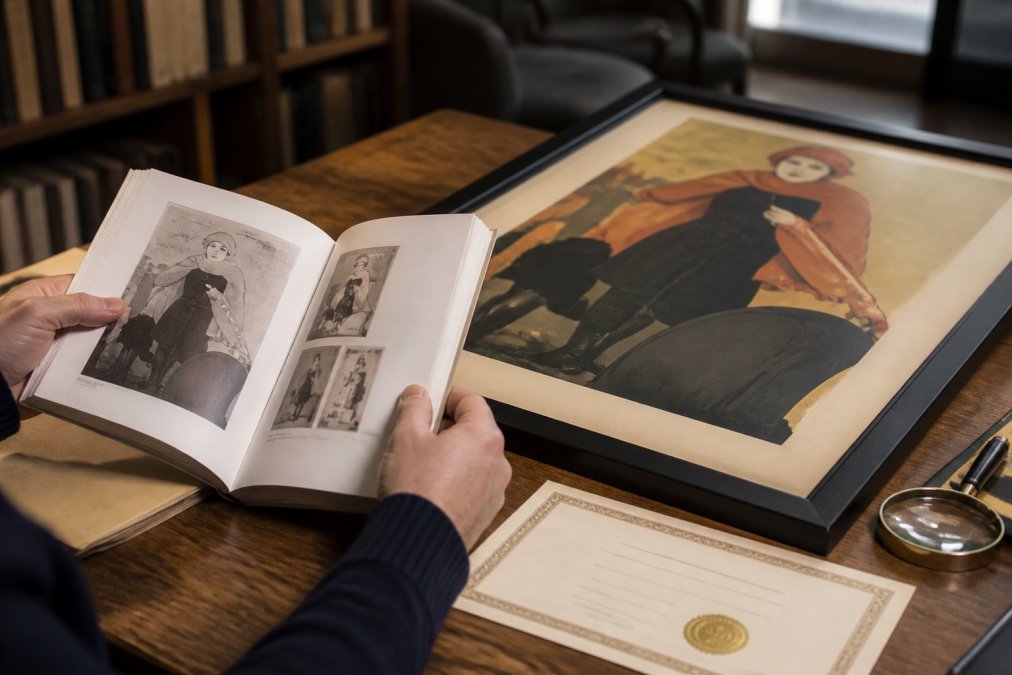
How to Spot Fake Vintage Paintings and Prints
The fastest way to catch a fake is to examine the printing method, not the image. An original mid-20th-century lithograph carries the grain and ink layering of stone or plate printing; a modern digital reproduction shows a uniform dot pattern under magnification.
Watch for these tells:
- Paper that is too white. Genuine vintage paper yellows with age. A bright, pristine sheet on a 60-year-old poster is a warning.
- Edges that look machine-cut. Original posters and prints often show slight irregularity from hand trimming.
- Reproduction stamps or "estate" marks added to modern reprints to imply legitimacy.
- Colors that seem too saturated. Restored or overpainted pieces lose value, and original bright color that survived decades is genuinely rare.
A piece can be genuinely old and still be a fake in the sense that matters: age does not equal authenticity.
Vintage Art Authentication Services: What They Do and When to Use Them
Most guides treat "authentication" as a checkbox, buy the piece, get a certificate, done. That framing is why so many buyers get burned. Authentication is not a single document but a layered verification protocol, and understanding the layers separates a confident purchase from an expensive lesson.
The four verification layers, in order of evidentiary weight:
- Catalogue raisonné confirmation. For any artist with a published catalogue raisonné, a matching entry is the strongest single piece of evidence, giving title, date, medium, dimensions, edition size, and known impressions. If a seller cannot name the catalogue number, that is a gap, not a detail.
- Physical marker examination. Paper stock, watermark, chain lines, plate mark, ink layering, and signature placement are checked against known reference examples. A conservator or experienced dealer can distinguish a stone lithograph from an offset reprint under low magnification by ink structure alone, where most reproductions fail.
- Provenance documentation. Auction records, gallery receipts, estate inventories, exhibition labels, and prior owner correspondence build the chain of custody. One strong document, such as an original gallery invoice, can outweigh several weak ones.
- Expert opinion. A recognized specialist in the artist or category issues a written opinion. This is the layer most buyers over-rely on and the one most subject to revision.
- The asking price is high enough that a wrong call would materially hurt you.
- The seller's documentation has gaps you cannot close through research.
- You intend to resell, insure, or donate the piece and need third-party backing.
- The attribution is to a well-known name and the price seems low for it.
U.S. Copyright Office guidance on reproduction and originality
Where to Buy Authenticated Vintage Art Online: Marketplaces and Dealers
The safest purchases come from dealers who specialize in a category and stand behind their descriptions. A general marketplace with millions of listings offers volume but little accountability; a focused dealer who handles only vintage posters, historical photographs, or marine fine art knows the reference literature and answers provenance questions directly.
Roy Lichtenstein Authentic Original →
When evaluating any source, check for:
- A written authenticity guarantee with a clear remedy
- Detailed condition reports with photographs of flaws
- A return window long enough to allow independent inspection
- Willingness to share prior ownership or auction history
U.S. Copyright Office guidance on reproduction and originality
Pricing Authenticated Vintage Art: Affordable Finds vs. Investment Pieces
Price tracks three things: artist reputation, rarity, and condition. A well-known name in excellent condition commands a premium, while a lesser-known artist in comparable condition costs far less, where newer collectors often find the best value.
| Tier | Typical Range | What You Get | Best For |
|---|---|---|---|
| Entry | Under $1,000 | Historical photographs, unsigned prints | First-time buyers |
| Mid | $1,000 - $2,500 | Original lithographs, WWI posters | Serious collectors |
| Investment | $2,500+ | Rare advertising, large-format originals | Portfolio building |
Shipping, Handling, and Returns for Fragile Vintage Art
Fragile art fails in transit more often than on the wall. Paper tears, linen backing creases, and frames crack when packaging is improvised. A seller who ships vintage material regularly has a standard method: rigid backing, archival tissue, and a moisture barrier.
Before you buy, confirm:
- Whether large pieces ship rolled in a tube or flat in a crate
- Whether linen-backed items travel with corner protection
- What insurance covers damage in transit
- How long you have to inspect and return
Legal and Ethical Sourcing: What Buyers Should Know
This is the section most buying guides skip, and it can cost you the piece years after you buy it. A purchase is only as clean as its source, and art and collectibles carry legal complications when provenance is unclear, particularly around cultural property, wartime-era items, and objects subject to import or export restrictions.
The categories that carry the most legal risk:
- Cultural property from source countries with patrimony laws. Many nations vest ownership of archaeological and cultural material in the state, which means a piece that left the country without a permit can still be claimed decades later. The U.S. implements the 1970 UNESCO Convention through the Cultural Property Implementation Act, which restricts import of certain categories of archaeological and ethnological material from participating countries.
- Wartime-era European art. Works that changed hands in Europe between 1933 and 1945 require careful provenance review. The standard reference for this is the American Alliance of Museums' Nazi-era provenance guidelines, which many dealers and auction houses now follow voluntarily.
- Native American and Indigenous objects. Federal law restricts the sale and transport of certain Native American cultural items, and buyers should confirm a piece is legally marketable before purchase.
- Protected wildlife materials. Ivory, tortoiseshell, and certain woods used in antique frames and inlays are subject to federal and state restrictions, and interstate commerce rules can apply even when the piece is genuinely antique.
- Where did this piece come from, and through what channel?
- Is there any restriction on its ownership, import, or resale?
- Was it acquired through a documented estate, auction, or dealer transaction?
- Will the seller put the sourcing history in writing?
American Alliance of Museums Nazi-era provenance guidelines
Conclusion: Building a Collection You Can Trust
The challenge with vintage art is not finding something beautiful. It is finding something beautiful that is also genuine, and being able to prove it years later when you sell or insure it.
Frequently Asked Questions
How can you tell if vintage art is authentic?
Authentic vintage art carries physical and documentary evidence. Look for a certificate of authenticity, original gallery or publisher stamps, and a catalog raisonné reference. Paper should show age-appropriate toning, not fresh white brightness. Check the print method under magnification: original lithographs have irregular ink texture, while reproductions show uniform dot patterns.
What is the best way to verify the provenance of vintage art?
Start with the seller's documentation: auction records, gallery receipts, exhibition history, and previous owner names. Cross-reference the piece against published catalogues raisonnés for the artist. Ask for high-resolution images of any labels, stamps, or inscriptions on the verso. A reputable seller will provide a complete ownership chain. Provenance gaps are not always red flags, but they should lower your offer.
Is it safe to buy vintage art online?
It is safe when you buy from sellers who guarantee authenticity in writing and offer a return policy. Avoid sellers who refuse returns or cannot explain provenance.
What are the red flags when buying vintage art online?
Watch for prices far below market value, blurry photos that hide condition issues, vague provenance claims, and sellers who pressure you to buy quickly. Missing or generic certificates of authenticity are another warning sign. If the seller cannot provide close-up images of signatures, paper texture, or printer's marks, walk away. Also be cautious of listings that use the same stock photo across multiple platforms. A legitimate dealer will answer detailed questions and provide documentation without hesitation.