


Buy Guaranteed Original Historical Photographs: 2026 Guide
Table of Contents
- Why Guaranteed Original Historical Photographs Are Worth the Investment
- Understanding Historical Photograph Types and Printing Processes
- How to Authenticate Vintage Photographs Like an Expert
- Historical Photograph Provenance Documentation: What to Look For
- Best Ways to Frame Antique Photographs for Preservation and Display
- Market Valuation: What Drives the Price of Original Photographs
- Where to Buy Guaranteed Original Historical Photographs
- Frequently Asked Questions
Last Updated: September 21, 2026
Why Guaranteed Original Historical Photographs Are Worth the Investment
A guaranteed original historical photograph is a first-generation print made from the original negative during or near the time the image was captured, with documentation proving its origin. At CV Treasures, we've built our entire catalog around that standard: owner-sourced pieces, no reproductions, no fakes. The difference between a genuine vintage print and a later copy isn't just academic; it's the difference between owning a piece of visual history and owning a picture of one.
Historical photographs hold value for three reasons: scarcity, provenance, and emotional connection to a moment in time. A single surviving press photo from a defining event carries more weight than a thousand digital files of the same scene.
Below, we'll show you exactly how to authenticate, value, and buy guaranteed original historical photographs without getting burned.
Understanding Historical Photograph Types and Printing Processes
The printing process used to create a photograph tells you its era, its rarity, and often its value. Knowing your albumen from your gelatin is the first step toward buying with confidence.
Albumen Prints, Cabinet Cards, and Tintypes
Albumen prints dominated from the 1850s to the 1890s, recognizable by their warm sepia tone and thin, glossy paper mounted on card stock. Cabinet cards measure roughly 4.25 by 6.5 inches and were the standard portrait format for Victorian households. Tintypes, despite the name, are made on thin iron sheets coated with a light-sensitive emulsion, popular for their durability and low cost.
Each type carries distinct surface characteristics. A common mistake is assuming a yellowed photograph is automatically old; modern reproductions often mimic that patina artificially.
Silver Gelatin and Type I Press Photos
Silver gelatin prints became the standard from the late 1800s through the 20th century, prized for their sharp blacks and fine tonal range. A Type I press photo is a first-generation print made from the original negative within roughly two years of the event, often stamped or captioned by the news agency that used it.
Type I photos command a premium because they are, by definition, closest to the source.
How to Authenticate Vintage Photographs Like an Expert
Authentication combines paper analysis, ink dating, and provenance research. No single test proves authenticity; the strongest conclusions come from multiple converging signals. Most practitioners treat authentication as a layered process, each layer narrows the probability that a print is a later reproduction.
Forensic Authentication Techniques
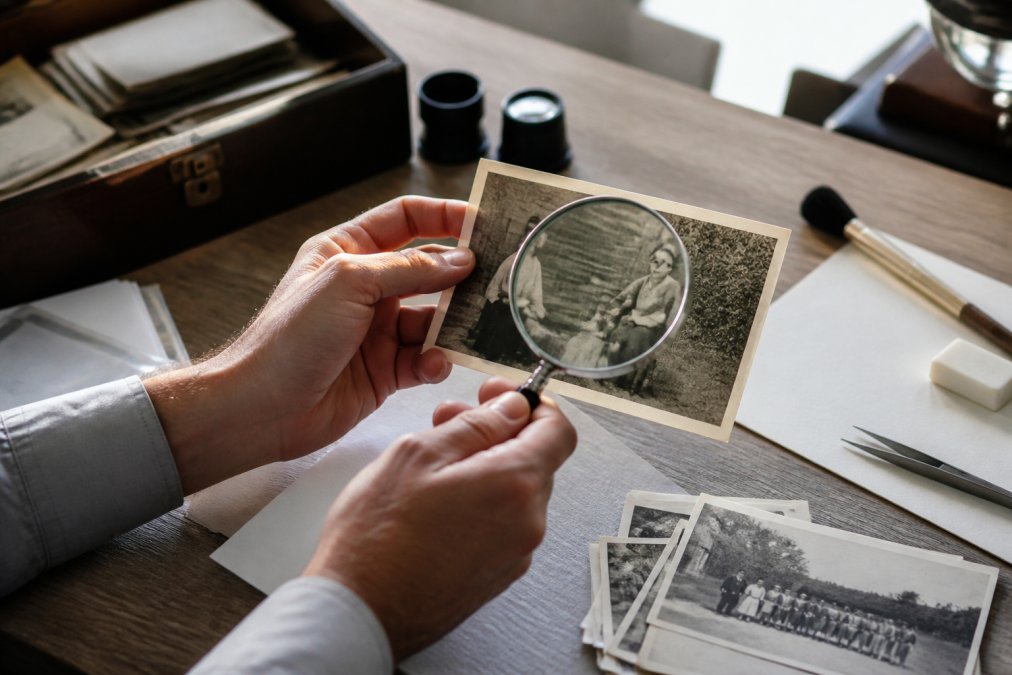
Forensic methods go deeper than the naked eye. A 10x loupe inspection reveals paper fiber structure, cotton rag, wood pulp, and resin-coated stocks each have distinct signatures that correspond to specific manufacturing eras. Ultraviolet light reveals restoration and inpainting that's invisible under normal viewing, and it also exposes modern optical brighteners in paper that didn't exist before the mid-20th century.
A practical sequence most experienced authenticators follow:
- Loupe inspection (10x-20x): Check fiber structure, surface gloss, and whether the image sits in an emulsion layer or is printed onto the paper surface.
- UV fluorescence: Modern papers glow blue-white under UV; period papers typically appear dull or dark. Brighteners are one of the hardest things for a reproduction to fake.
- Raking light: Reveals embossing, plate marks, and surface deformation consistent with period printing.
- Ink and stamp dating: Compare stamp typography, ink color, and cancellation marks against known agency examples from the same era.
- Provenance cross-check: Match the print against publication records, estate inventories, or auction archives.
Digital vs. Physical Provenance
In an increasingly digital market, the chain of custody for a physical print can be tracked two ways. Physical provenance relies on stamps, receipts, auction records, and estate paperwork. Digital provenance uses high-resolution scans, condition reports stored as PDFs, and, for higher-value pieces, third-party authentication databases that log prior sales and grading results. The strongest files combine both: a physical paper trail backed by a digital record that travels with the print when it changes hands.
Historical Photograph Provenance Documentation: What to Look For
Provenance documentation is the paper trail that connects a photograph to its origin. Strong provenance includes original stamps, dated captions, publication records, and, where applicable, third-party authentication.
Look for these markers when reviewing a piece:
- Original agency or studio stamps on the reverse
- Handwritten captions or dates matching the era
- Publication records or matching magazine issues
- Authentication certificates from recognized grading services
- Chain of custody from prior owners or estate collections
Legal and Copyright Status
Ownership of a physical photograph is separate from copyright in the image. A collector can own an original print while the underlying rights remain with the photographer's estate or a corporate successor. According to U.S. Copyright Office guidance on works, copyright duration for older works depends on publication status and renewal records, so buyers should verify status before any commercial use.
Best Ways to Frame Antique Photographs for Preservation and Display
The best ways to frame antique photographs prioritize archival materials over aesthetics. A beautiful frame that damages the print is a bad trade.
Use these standards:
- Archival-quality matting: acid-free, lignin-free board only
- UV-filtering glazing: blocks light damage without hiding detail
- No direct mounting: hinges or corner pockets, never glue or tape
- Stable environment: avoid attics, basements, and direct sunlight
Market Valuation: What Drives the Price of Original Photographs
Valuation rests on four pillars: subject significance, print generation, condition, and provenance. A first-generation Type I photo of a major historical figure in excellent condition with strong documentation sits at the top of the market. A later copy of the same image, even if visually similar, sits far below.

| Factor | Raises Value | Lowers Value |
|---|---|---|
| Print generation | Type I, first generation | Later reprints |
| Condition | Sharp, minimal wear | Fading, tears, stains |
| Provenance | Original stamps, records | No documentation |
| Subject | Historical figures, iconic events | Generic scenes |
A Framework for Why One Photo Is Worth $50 and Another $5,000
Rarity alone doesn't explain price. Two prints of the same image can differ by two orders of magnitude. A workable framework weighs five multipliers:
- Print generation. A Type I print made from the original negative within roughly two years of the event is the top tier. Type II (made later from the original negative) and Type III (made from a copy negative) drop sharply. A Type I can be worth several times a visually identical Type III.
- Subject demand. Iconic figures and events with a broad collector base outperform niche subjects even when the niche print is rarer. Demand, not scarcity, sets the ceiling.
- Condition relative to age. A 150-year-old albumen print with light edge wear can grade higher than a 60-year-old silver gelatin print with the same visible flaws, because expected condition scales with age.
- Provenance strength. Original agency stamps, matching publication records, and a documented chain of custody can add a meaningful premium over an undocumented print of the same image.
- Market liquidity. Photographs tied to a well-documented collecting category, press photos, Hollywood publicity stills, civil rights imagery, space program prints, trade more often and price more predictably than one-off curiosities.
Investment Potential of Historical Images
Historical photographs have appreciated over long horizons, but the market is not uniform. Blue-chip categories, iconic press photos, major studio stills, and documented civil rights or space program imagery, have shown steadier demand than general vintage scenes. Buyers treating photographs as an investment should prioritize documented provenance, top-tier print generation, and subjects with an established collector base. Speculative buying on obscure subjects rarely pays off, and condition issues can erase gains entirely.
Where to Buy Guaranteed Original Historical Photographs
When comparing sellers, ask three questions: Is the piece owner-sourced? Is authenticity guaranteed in writing? Is there a return policy if condition doesn't match the description?
Frequently Asked Questions
How can you tell if a historical photograph is an original?
Look for physical clues like paper type, print process, and stamps. Original vintage prints often show natural aging, such as sepia toning or minor wear, and may have studio or publication markings on the back. Type I press photos from news archives typically include date stamps and captions. A certificate of authenticity from a reputable dealer, like CV Treasures, provides additional assurance that the piece is not a reproduction.
What documentation should accompany an original historical photograph?
Provenance documentation can include original stamps, publication clippings, handwritten notes, or letters from previous owners. For example, a 1953 Marilyn Monroe photograph might have an Esquire magazine stamp and a newspaper caption on the reverse. A certificate of authenticity from a trusted seller also helps. This paperwork establishes the chain of custody and supports the photograph's historical significance and value.
Are old photographs worth any money?
Yes, many old photographs hold significant value, especially those featuring historical figures, rare events, or iconic moments. Factors like rarity, condition, provenance, and subject matter drive prices. For instance, a Type I Marilyn Monroe photograph can sell for hundreds to thousands of dollars. Authenticated pieces with strong provenance and good condition tend to appreciate over time, making them both collectible and investable.
How do I verify the provenance of a vintage photograph?
Start by examining the back for stamps, notations, or labels from studios, newspapers, or archives. Cross-reference any names or dates with historical records. Request a certificate of authenticity and a condition report from the seller. Reputable dealers like CV Treasures provide detailed provenance documentation, ensuring the piece is owner-sourced and strictly original, with no reproductions or fakes.
The challenge with buying guaranteed original historical photographs is trust: too many reproductions masquerade as originals, and too many sellers won't stand behind their claims. CV Treasures addresses that directly with owner-sourced inventory, strict originality guarantees, and one-of-a-kind artifacts backed by documented provenance. Explore the curated collection and own a piece of history that's genuinely yours.