


Displaying Rare Artifacts in Home Offices: A Collector's Guide
Table of Contents
- Choosing the Right Display Cabinet for Your Home Office
- Wall-Mounted vs. Tabletop Displays: Space and Style Considerations
- Archival Display Cases for Home Offices: Conservation-Grade Protection
- How to Preserve Vintage Paper Artifacts in a Home Office Environment
- Curating a Professional Vintage Collection: Grouping and Arranging
- Security and Insurance for High-Value Artifacts in Home Offices
- Digital Inventory Management for Your Vintage Collection
- Conclusion
- Frequently Asked Questions
Last Updated: September 18, 2026
Choosing the Right Display Cabinet for Your Home Office
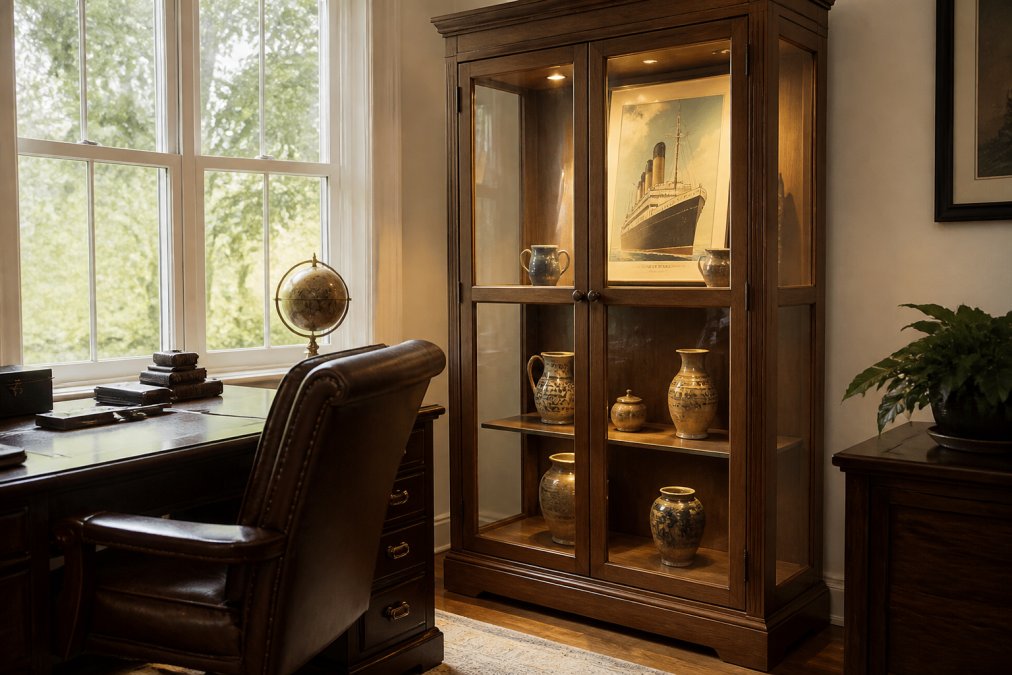
Displaying rare artifacts in home offices starts with one decision: what holds them when displaying rare artifacts. The right display cabinet protects your pieces from dust, light, and curious hands while turning a working space into a curated gallery.

Museum-quality cabinets share a few traits:
- Glass doors with a tight seal to block dust
- Solid wood or powder-coated steel frames that resist warping
- Adjustable shelving sized to your largest piece
- A backing that won't off-gas or stain paper
Measure your largest artifact first. A 30-by-40-inch poster needs a case at least 34 inches wide. Depth matters too: framed pieces 2 inches deep need a 6-inch-deep cabinet for airflow.
For high-value items, look for cases with lockable doors and UV-filtering glass. That single upgrade protects color and paper for decades.
Wall-Mounted vs. Tabletop Displays: Space and Style Considerations
Wall-mounted cases save floor space and lift pieces to eye level, which is where artifacts read best. Tabletop displays suit smaller items you want to rotate often. The choice comes down to square footage and how much you handle your collection.
| Factor | Wall-Mounted | Tabletop |
|---|---|---|
| Floor space used | None | 1-2 sq ft per unit |
| Best for | Posters, large frames | Coins, small ceramics |
| Viewing height | Eye-level | Desk height |
| Security | Harder to grab | Easier to reach |
| Rotation ease | Low | High |
Archival Display Cases for Home Offices: Conservation-Grade Protection
Archival display cases for home offices use acid-free materials and sealed enclosures to slow deterioration. These cases cost more, but they're the difference between a poster that lasts 20 years and one that lasts 100.
Reading the Materials List Like a Conservator
The word "archival" is not regulated for consumer display products, so the label alone tells you very little. What matters is the specific material behind it. Look for these designations on the product spec sheet or ask your framer directly:
- Mat board: "100% cotton rag" or "alpha-cellulose, lignin-free, buffered." Standard wood-pulp mat board contains lignin, which breaks down into acidic compounds and burns a brown line into paper over time.
- Backing board: Corrugated plastic (often sold as Coroplast) or acid-free foam board. Avoid plain cardboard, which is acidic and attracts pests.
- Adhesives and tapes: Wheat starch paste, methyl cellulose, or a documented reversible adhesive. Never rubber cement, masking tape, or standard double-sided tape.
- Glazing: Acrylic (Plexiglas) is lighter and shatter-resistant; glass is more scratch-resistant but heavier and riskier over a desk. Both are available with UV filtering.
- Mounting: Photo corners, Japanese paper hinges, or a custom sink mat. Nothing should be glued flat to a backing board.
The Real Trade-Offs
The Library of Congress preservation guidelines recommend storing paper items in stable, moderate humidity. That same logic applies to what you display.
When Archival Isn't Worth It
Not every piece justifies the cost. A signed first edition, an original engraving, or anything with documented provenance is worth conservation framing. A modern open-edition print you paid a few dollars for is not.
How to Preserve Vintage Paper Artifacts in a Home Office Environment
How to preserve vintage paper artifacts comes down to three enemies: light, moisture, and heat. Control those and most paper pieces hold their condition for decades.
Paper is fragile because it absorbs whatever is in the air. Smoke, humidity, and UV light all leave marks you can't undo.
Lighting Techniques for Artifacts Without UV Damage
The safest light for artifacts is LED with a low UV output, kept off when you're not in the room. Never hang a piece where direct sun hits it.
Rotate pieces that sit in bright spots. Even low-UV light fades inks over years.
Climate Control and Humidity Management
A simple hygrometer costs little and tells you what's happening. Run a dehumidifier in damp months and keep cases away from vents, radiators, and windows.
Curating a Professional Vintage Collection: Grouping and Arranging
Curating a professional vintage collection is about visual balance, not filling every wall. Group pieces by theme, era, or color so the eye finds a focal point instead of clutter.
Currier & Ives Hand-colored Engraving →
Start with an anchor piece, then build around it. A single strong artifact with breathing room beats five competing for attention.
Creating a Gallery Wall with Rare Artifacts
A gallery wall works when spacing stays consistent. Keep 2 to 3 inches between frames and align tops or centers.
Shadow Box Framing and Floating Shelves for Ceramics
Shadow box framing gives three-dimensional pieces depth behind glass. Floating shelves let ceramics and small objects sit at eye level without a case.
Security and Insurance for High-Value Artifacts in Home Offices
Security and insurance protect the investment, not just the object. Most homeowners policies cap collectibles, so a rider or separate policy is often necessary.
Why a Home Office Changes the Risk Picture
A home office is usually on the ground floor, often has a window facing the street, and is the room most likely to be shown to clients, contractors, and delivery workers. That combination raises both theft exposure and the number of people who know what you own.
Security Mechanisms That Actually Deter Theft
Locks and alarms work best in layers. A single measure rarely stops a determined thief, but stacked measures push them toward an easier target:
- Locking display cases: Look for cam locks or keyed cylinder locks, not simple friction latches. A glass case with a latch is a display, not a safe.
- Anchoring: Bolt freestanding cabinets to a wall stud or the floor. An unanchored case can be carried out whole.
- Window film: Security film on ground-floor office windows slows forced entry and is far cheaper than bars.
- A rated safe: For the highest-value pieces, a safe rated by Underwriters Laboratories (look for a UL burglary rating on the label) is the only real protection. A fire-rated safe and a burglary-rated safe are different products; check which rating you're buying.
- Alarm coverage: A monitored alarm with a glass-break sensor in the office is more useful than a door sensor alone, since ground-floor windows are a common entry point.
- Discretion: Don't post close-up photos of high-value pieces with identifiable room details on social media.
How Collectibles Insurance Actually Works
Standard homeowners policies usually treat collectibles as personal property subject to a sub-limit and a deductible, and they often exclude or underpay for items that are hard to value. The practical fix is scheduled coverage, a rider or a stand-alone collectibles policy that lists each item and its agreed value.
The Insurance Information Institute notes that valuable items often need scheduled coverage. Talk to your agent before a loss, not after.
Documentation That Survives a Loss
Photograph each piece and note its provenance. Keep purchase receipts and authentication papers. Store copies off-site or in the cloud. Add a rider to your homeowners policy. Use a safe or locked case for the most valuable items. Then go one step further: keep a single dated inventory document that lists every piece, its value, and where its paperwork lives. If a fire or theft happens, that one file is what your claim is built on.
Digital Inventory Management for Your Vintage Collection
Digital inventory management keeps your records, values, and provenance in one place. A simple spreadsheet beats memory every time.
Conclusion
Building a home office gallery takes planning, but the payoff is a space that tells your story. The hard part is sourcing pieces you can trust. CV Treasures offers owner-sourced, guaranteed authentic artifacts with no reproductions or fakes, from Currier & Ives engravings to authenticated sports and entertainment memorabilia. Every piece is one of a kind, ready to anchor your collection. Start with CV Treasures and turn your office into a gallery worth showing off.
Frequently Asked Questions
What are the best lighting techniques for displaying rare artifacts without causing UV damage?
Use LED lights and avoid direct sunlight, which can fade inks and papers. For framed pieces, install UV-filtering glazing. Rotate light exposure to limit cumulative damage.
How do I protect vintage paper artifacts from humidity and temperature fluctuations in a home office?
Maintain stable humidity and temperature. Avoid placing artifacts near vents, windows, or exterior walls. For valuable pieces like the Currier & Ives engraving, consider a conservation-grade frame.
How can I secure high-value artifacts in a home office setting?
Install locking display cases or cabinets. Anchor shelving to wall studs. Document each item with photographs and appraisals for insurance purposes. Keep a detailed inventory, including provenance documents.
What materials should I avoid when displaying antique items?
Avoid materials that release harmful gases. Never use cardboard, newspaper, or standard tape for storage or mounting. Instead, choose archival-quality materials. If framing, specify UV-filtering glass and acid-free backing boards.