


How to Verify Vintage Poster Authenticity: 2026 Guide
Table of Contents
- Start with the Paper: Texture, Weight, and Aging
- Vintage Poster Printing Techniques: Lithography vs. Offset
- Signs of a Poster Reproduction: What to Look For
- How to Identify Original Movie Posters: Beyond the Image
- Advanced Tools: UV Light, Magnification, and Digital Verification
- Provenance and Documentation: Building a Case for Authenticity
- The Legal and Ethical Side of Buying Vintage Posters
- Conclusion: Your Checklist for Confident Collecting
- Frequently Asked Questions
Last Updated: September 12, 2026
Start with the Paper: Texture, Weight, and Aging
The fastest way to verify vintage poster authenticity is to examine the paper before the image. Originals were printed on paper stocks that age predictably, and reproductions reveal themselves through the substrate.
Run your fingertips across the surface. Authentic vintage posters have a matte texture with slight irregularities; modern reproductions feel uniformly smooth or artificially distressed. Hold the poster to light and look for "foxing," the small brown spots aged paper develops through oxidation. Genuine aging is random; fake aging looks sprayed on or too even.
Weight matters too. Older posters are lighter and more brittle than modern offset reproductions. Stiff, pristine paper on something supposedly from the 1940s is a red flag.
Vintage Poster Printing Techniques: Lithography vs. Offset
Lithographic printing dominates genuine vintage posters produced before the 1960s, while offset reproduction defines most modern reprints. Knowing which technique created your poster tells you almost everything about its authenticity.
Stone and zinc plate lithography produce distinct characteristics. Under magnification you'll see irregular ink deposits, subtle saturation variations, and softness at the edges of color fields, the uneven plate transfer proves age.
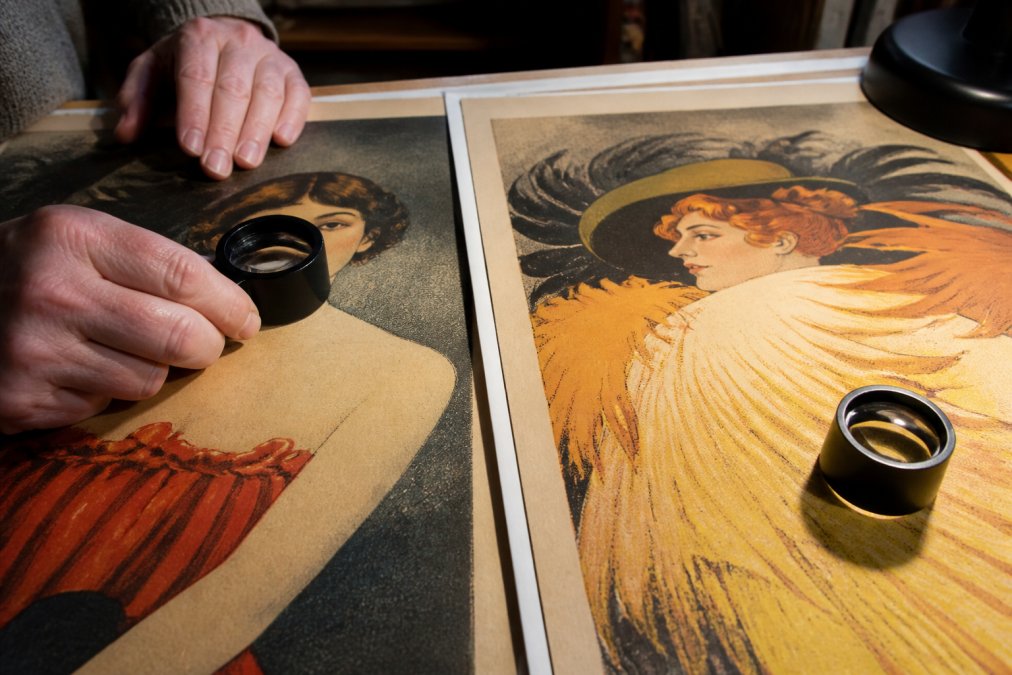
Offset printing produces uniform ink coverage and crisp edges. Perfectly consistent color across large areas signals a modern reproduction, and the four-color process creates a distinctive dot matrix visible under a 10x loupe.
| Feature | Lithography (Original) | Offset (Reproduction) |
|---|---|---|
| Ink texture | Irregular, varied saturation | Uniform, flat coverage |
| Edge quality | Soft, slightly blurred | Crisp, sharp |
| Dot pattern | None or organic | Regular halftone dots |
| Color depth | Layered, dimensional | Flat, single-pass |
| Typical era | Pre-1960s | 1960s to present |
Signs of a Poster Reproduction: What to Look For
The clearest signs of a poster reproduction hide in details most buyers overlook: margins, typography, ink layering, and printer's marks. Each is a physical cue you can check in under a minute.
Margins and trim. Originals were often hand-trimmed or cut from larger press sheets, so margin widths vary side to side, sometimes by a quarter inch or more. Run a ruler along all four edges: perfectly uniform margins point to a machine cut, standard for modern reprints. Originals may also retain printer's marks, registration crosses, color bars, trim marks, which reprints lack.
Typography and font fidelity. Under magnification, lithographic type has soft, feathered edges where ink wicked into the paper; offset type is razor-sharp. A subtler tell is font substitution: reprints swap the original typeface for a close but wrong match, so tracking looks too even or a serif has the wrong terminal shape. Compare the title lettering against a known original.
Ink layering and depth. Originals built color through multiple press passes, so overlapping color fields have a slight dimensional quality under raking light. Modern reproductions apply color in a single flat pass. If a large color field looks like one coat of paint at a low angle, treat it as a reprint.
The back of the sheet. Originals often show ink set-off, the faint mirror image transferred when posters were stacked before the ink cured. A perfectly white, clean back on a piece supposedly printed decades ago is a warning sign. Also check for a watermark or printer's imprint.
Reproduction tells at a glance. A few patterns show up again and again on modern reprints:
- A copyright line or a modern publisher's name printed in the image or margin
- A glossy or coated surface on a piece that should be matte
- Colors that are too saturated or too uniform compared to a known original
- A size that matches a common modern reprint dimension rather than the original format
- A back that is bright white with no set-off, foxing, or storage staining
Common forgery techniques. Beyond straight reprints, watch for:
- Digital reprints of public-domain images. A high-resolution scan reprinted on aged-looking paper. The giveaway is a halftone dot pattern under magnification, which a true stone or zinc lithograph will not show.
- Chemical or tea aging. Paper stained to mimic patina; the color is too even and often bleeds into the image rather than sitting only on the paper.
- Married pieces. A genuine poster trimmed and mounted onto a different backing, or a real image paired with a fabricated margin and signature.
- Reproduction of a rare variant. A common reprint passed off as a scarce colorway or first printing. Cross-check the exact color and text against a catalog entry before paying a premium.
If you find a halftone dot pattern under a loupe on a piece that should be a pre-1960s lithograph, stop there. That single test resolves most authenticity questions faster than any other check.
How to Identify Original Movie Posters: Beyond the Image
Movie posters have their own authentication rules, and the image alone tells you little. Studios printed in standardized sizes, and any deviation signals a reproduction.
Original movie poster sizes follow established standards: a one-sheet measures 27 by 41 inches, and half-sheets, inserts, and lobby cards each have their own dimensions (loc.gov). A poster claiming to be an original one-sheet but measuring 24 by 36 inches is a standard modern reprint size.
Beyond dimensions, look for the National Screen Service (NSS) number. Original theatrical posters from the mid-20th century typically carry one in the lower corner identifying the film and release year. Its absence, or a number that doesn't match the film's release, indicates a reproduction.
Paper stock for movie posters was often newsprint-like, thinner and more porous than fine art paper. That newsprint feel is difficult to replicate, and reproductions usually feel noticeably heavier or glossier.
Advanced Tools: UV Light, Magnification, and Digital Verification
Most guides stop at "use a loupe." Here's what to look for once you have one, because the microscopic and digital checks are where confident authentication happens.
UV light: reading the fluorescence. Under ultraviolet light, modern papers and inks fluoresce blue-white from optical brighteners added during manufacturing; original vintage posters from before the 1960s typically show dull or no fluorescence. Work in a dim room, hold the light a few inches from the surface, and sweep slowly. A bright blue-white glow means modern stock; a dull response is consistent with older paper. Some later papers and restoration materials also fluoresce, so treat UV as one signal, not a verdict.
Magnification: the halftone versus litho test. The single most useful microscopic check, and the one most guides skip. Use a 10x to 30x jeweler's loupe or a USB microscope on a solid color field and the image edge.
- Offset and digital reprints are built from a regular grid of halftone dots. Under magnification you see evenly spaced dots of varying size, often in a rosette pattern where the cyan, magenta, yellow, and black screens overlap. The dots sit on top of the paper.
- Stone and zinc plate lithographs show no regular dot grid. Instead you see irregular ink deposits, subtle variations in saturation, and a softness at the edges of color fields where ink wicked into the paper fibers. The ink penetrates the sheet rather than sitting on the surface.
A halftone dot pattern on a poster that should predate the 1960s is one of the strongest single indicators of a reproduction. Photograph the dot pattern through the loupe with your phone; it is the clearest evidence you can show a seller or an authentication service.
Paper fiber and surface. At 30x, older paper shows visible, irregular fibers and a slightly rough surface; modern coated stock looks smooth and uniform, sometimes with a faint sheen. Synthetic-looking fibers or a calendered, glossy surface mean modern paper regardless of the image.
Digital verification: cross-referencing the record. None of the top guides cover this, and it is the fastest way to catch a mass-produced reprint. Use these steps:
- Reverse image search. Upload a photo of the poster to a reverse image search engine. If the same image appears across dozens of listings, auction sites, and print-on-demand shops, you are almost certainly looking at a mass reproduction rather than a scarce original.
- Catalog and database cross-reference. Search known poster catalogs and auction archives by title, printer, and year. These records list documented sizes, printers, and known variants. If your poster's size or printer does not match any cataloged example, that mismatch is a red flag.
- Serial and printer numbers. For movie posters, the National Screen Service number and the printer's code in the lower margin identify the film, the release, and the printing run. Search that number against known records. A number that does not match the film's actual release, or that appears on many identical listings, points to a reproduction.
- High-resolution comparison. Some authentication services scan a poster at high resolution and compare paper texture, ink composition, and dot structure against known originals. This is the most rigorous option and is usually reserved for high-value pieces.
Putting the tools together. Run the checks in order: UV for a quick paper read, the loupe for the halftone-versus-litho test, then digital cross-referencing for the paper trail. When all three agree, you have a defensible authentication; when they disagree, trust the physical evidence over the listing description.
Provenance and Documentation: Building a Case for Authenticity
Provenance, the documented history of ownership, remains the strongest single indicator of vintage poster authenticity. A clear paper trail commands more confidence than physical characteristics alone.
Good provenance includes auction house receipts, dealer invoices, gallery records, and exhibition history, plus original studio or printer documentation. For sports memorabilia and historical photographs, third-party authentication services provide independent verification.
At CV Treasures, every piece is owner-sourced and strictly original, with no reproductions or fakes. For collectors burned by unverifiable listings, a clear paper trail is the difference between confidence and doubt.
When evaluating provenance, ask: Who owned it before? How did they acquire it? Can any of that be documented? Vague answers mean treat the poster as unverified, however good it looks.
The Legal and Ethical Side of Buying Vintage Posters
Selling a reproduction as an original is fraud, plain and simple. Federal and state consumer protection laws prohibit deceptive trade practices, and the Federal Trade Commission's guidance on deceptive advertising makes clear that material misrepresentations about a product's origin and authenticity violate the law.
The ethical dimension matters just as much. Reputable dealers disclose what they know and label reproductions as reproductions, even when a buyer might not notice. That transparency protects the entire market, because every forgery scandal erodes collector confidence.
For buyers, the practical takeaway is simple: demand written authentication. A seller who guarantees authenticity in writing has legal exposure if the claim proves false. A seller who won't put it in writing is telling you something important. The U.S. Copyright Office also matters here, since some reproductions infringe on protected designs, and unauthorized reprints can be seized.
Conclusion: Your Checklist for Confident Collecting
Use this checklist before any purchase:
- Paper shows matte texture, foxing, or natural aging patterns
- Printing method matches the era (lithography for pre-1960s, no halftone dots)
- Dimensions match known standard sizes for the format
- Margins show hand-cut irregularities, not machine precision
- Typography has the slight softness of lithographic printing
- UV light test shows no bright fluorescence
- Magnification reveals ink penetrating paper fibers, not sitting on top
- Provenance documentation exists and can be verified
- Seller provides written authentication guarantee
Verifying vintage poster authenticity takes practice, but the physical evidence rarely lies. The challenge is knowing what to look for and having a trusted source for pieces that already pass every test. CV Treasures specializes in owner-sourced, guaranteed authentic vintage posters, historical photographs, sports memorabilia, and marine fine art, with every piece strictly original. To skip the guesswork and collect with confidence, explore the CV Treasures collection and own a piece of history that's verifiably real.
Frequently Asked Questions
How can I tell if a vintage poster is real?
Start by examining the paper for signs of aging like foxing or patina. Check the printing method: originals often show halftone dots under magnification, while reproductions may have smooth, continuous tones. Look for margin irregularities and provenance documentation. UV light can reveal modern inks that fluoresce. If unsure, consult a professional authenticator like PSA for a thorough evaluation.
What are the most common signs of a poster reproduction?
Common signs include uniform paper color with no patina, perfect margins, and printing that lacks the dot matrix pattern of lithography. Reproductions often use offset printing with four-color process, resulting in less ink saturation and sharpness. They may also have modern copyright marks or barcodes. Always compare the paper stock to known originals and check for a newsprint feel versus a matte texture.
How does paper aging affect vintage poster value?
Paper aging can increase value if it shows authentic patina and foxing, which indicate age and history. However, severe damage like tears or water stains can decrease value. Linen backing is often used to stabilize and restore fragile posters, which can enhance value if done professionally. Always consider the overall condition and rarity when assessing value.
Can digital tools help verify vintage poster authenticity?
Yes, digital tools like high-resolution scanners and image analysis software can compare your poster to known originals. Online databases and forums for collectors can provide reference images. However, these tools are not foolproof. Combine digital verification with physical examination and provenance research for the best results. When in doubt, seek expert authentication.