


CVTreasures
HARRY HOUDINI HANDBILL Rare Vintage Antique Poster Handbill Herald Young’s Pier Theatre in Atlanic City, NJ Magic Memorabilia 1908
HARRY HOUDINI HANDBILL Rare Vintage Antique Poster Handbill Herald Young’s Pier Theatre in Atlanic City, NJ Magic Memorabilia 1908
Make an Offer
Couldn't load pickup availability
Harry Houdini Original Vintage Magic Memorabilia Collectibles Autographs For Sale
Harry Houdini
Rare Antique Vintage HOUDINI Poster Handbill Herald
1908
LARGE Style "HOUDINI" Lettering
Amazing Piece of History!
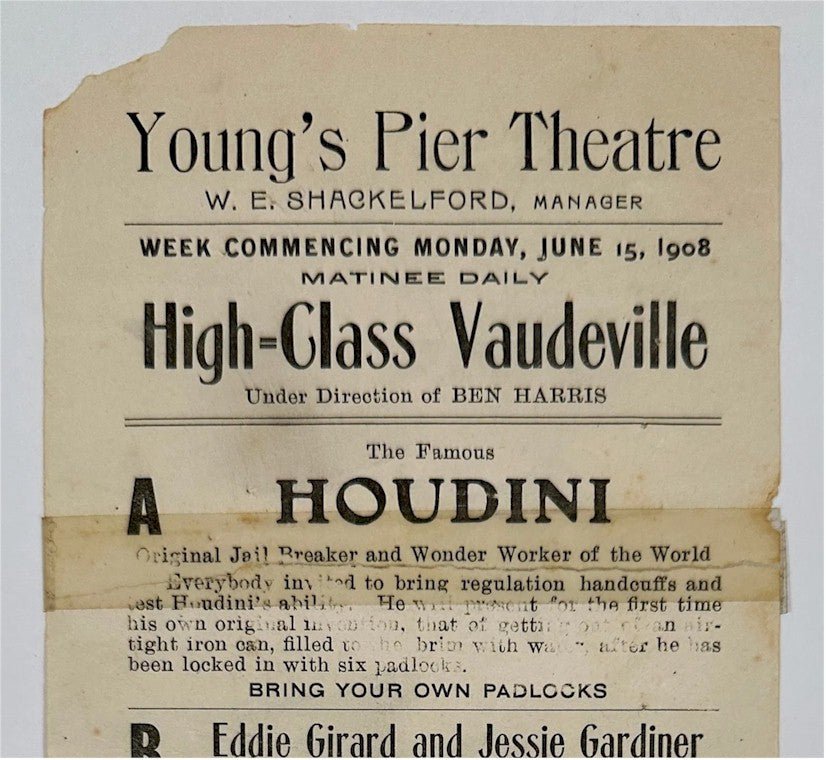
What we are offering here is an Amazing RARE Original small size promo poster handbill for a Houdini Event in 1908 with Houdini headlining this even at the Historic Young’s Pier Theatre in Atlanic City, New Jersey . This is a particularly attractive Houdini Challenge Handbill with its extraordinarily Large size Font "HOUDINI" headlines.
CONDITION: Age wear as would be expected for an Authentic 120 year old piece of history like this. The section with "HOUDINI" headline was apparently detached and reattached with tape. Very vintage age toning and small chip from upper left corner (Not effecting the poster printing). Has Not been mounted. Some of the Houdini text is slightly faded but all readable.
* Larger then most handbills which are typically 4x6" or 5x7"
Size: 4x10.25"
* See enlargeable images
Handbill printed Houdini text reads as follows:
"HOUDINI
Original Jail Breaker and Wonder Worker of the World. Everybody invited to bring regulation handcuffs and best Houdini’s ability. He will present for the first time his own original invention,. that of getting out of an air-tight iron can, filled to the brim with water, after he has been locked in with six padlocks. BRING YOUR OWN PADLOCKS"
* An EXTREMELY Rare discovery as this is the first we have even seen of this Houdini Handbill and suspect it is the Only one to exist for this Historic early 20th century NJ appearance.
Here’s a concise history of Young’s Pier Theatre:
Tied to one of Atlantic City’s most famous amusement piers, Young’s Pier Theatre was part of Young’s Million Dollar Pier in Atlantic City, New Jersey, a major entertainment destination in the early 20th century. Captain John L. Young built the pier — opened on July 26, 1906 — as a grand amusement pier with rides, exhibits, the world’s largest ballroom, an aquarium, and a large theatre among its attractions. The theatre, sometimes referred to in later years as Young’s Million Dollar Steel Pier Theatre, served as a venue for vaudeville, stage shows and motion pictures, drawing crowds to the Boardwalk’s lively seaside entertainment scene. It was typical of Atlantic City’s golden era of piers, which combined amusement rides, live performance spaces and cinemas.
Over the decades, the pier changed management and purpose; spaces that once hosted large theatrical productions were repurposed or demolished as tastes and economics shifted. The original Million Dollar Pier complex — including its theatre spaces — declined mid-century and was ultimately removed; a new pier and retail complex replaced it after a fire in 1981 destroyed much of the remaining structure.
In short, Young’s Pier Theatre was once a vibrant part of Atlantic City’s entertainment landscape, offering live and cinematic shows on a famous amusement pier built to rival any seaside attraction. Today it survives only in historical accounts and memorabilia from the city’s early amusement heyday.
This 120 year old paper has subtle age toning and is so lightweight that we placed the Historic Houdini Challenge in a double protective plastic sleeve so it can be viewed and enjoyed without having to pull it out and risk tearing the fragile paper. To show you, we have done a brief video.
* Note: Photo not included but just to show how amazing this historic piece will look framed with such a photo (which similar photos can be easily found online).
HARRY HOUDINI HANDBILL
Young's Pier Theatre, W.E.. Shackelford, manager. High class vaudeville under the direction of Ben Harris featuring the famous Houdini, 1908. Handbill mounted on board, tape and areas of minute loss among Houdini billing. 4"X10"
Size: 4x10"
NOTE: These are Very Rare and this may be the Only surviving example of this specific Houdini Challenge Handbill Poster as we have never see another before in our 42 years collecting.
HISTORY of HANDBILLS:
Theater Handbills (very similar to theater Heralds) go all the way back to the 16th century when there was no mass media. The theatres would take the handbill and/or herald and make copies to be handed out by theatre employees on street corners or in front of the theatre. If the theatre did not want to make the copies, there were several secondary printers that were set up to sell the heralds in quantities.
The first public theatre in England opened in London in 1576. Performances at the early theatres were announced by the distribution of handbills (small flyers circulated by hand), a drum procession through the streets, and by a flag hoisted at the theatre where the performance was taking place.
Playbills have fallen out of fashion, but they were the main form of advertising in the Nineteenth Century. They were a simple list of the coming attractions written in attractive fonts. Large copies were displayed as posters in the streets and smaller versions were also handed out as handbills.
Harry Houdini, wanting to keep costs down from the more expensive large broadsides, depended on handbills for promoting his act in the USA and England. Very few of these early 20th century advertising treasures survived and hence are Rarely seen for sale.
GUARANTEED AUTHENTIC for LIFE
* See enlargeable images
Note: Many historians, magicians and escape artists that spent a lifetime trying to figure out How Houdini did his seemingly impossible escapes were so frystrated they could never solve the Houdini puzzle, they resorted to, “Houdini must have been in on the act”. But, of course they could never orive that either!
Houdini first attracted notice in vaudeville in the United States and then as "Harry 'Handcuff' Houdini" on a tour of Europe, where he challenged police forces to keep him locked up. Soon he extended his repertoire to include chains, ropes slung from skyscrapers, straitjackets under water, and having to escape from and hold his breath inside a sealed milk can with water in it.
From 1907 and throughout the 1910s, Houdini performed with great success in the United States. He freed himself from jails, handcuffs, chains, ropes, and straitjackets, often while hanging from a rope in sight of street audiences. Because of imitators, Houdini put his "handcuff act" behind him on January 25, 1908, and began escaping from a locked, water-filled milk can. The possibility of failure and death thrilled his audiences. Houdini also expanded his repertoire with his escape challenge act, in which he invited the public to devise contraptions to hold him. These included nailed packing crates (sometimes lowered into water), riveted boilers, wet sheets, mail bags, and even the belly of a whale that had washed ashore in Boston. Brewers in Scranton, Pennsylvania, and other cities challenged Houdini to escape from a barrel after they filled it with beer.
In 1904, the London Daily Mirror newspaper challenged Houdini to escape from special handcuffs that it claimed had taken Nathaniel Hart, a locksmith from Birmingham, five years to make. Houdini accepted the challenge for March 17 during a matinée performance at London's Hippodrome theatre. It was reported that 4000 people and more than 100 journalists turned out for the much-hyped event. The escape attempt dragged on for over an hour, during which Houdini emerged from his "ghost house" (a small screen used to conceal the method of his escape) several times. At one point he asked if the cuffs could be removed so he could take off his coat. The Mirror representative, Frank Parker, refused, saying Houdini could gain an advantage if he saw how the cuffs were unlocked. Houdini promptly took out a penknife and, holding it in his teeth, used it to cut his coat from his body. Some 56 minutes later, Houdini's wife appeared on stage and gave him a kiss. Many thought that in her mouth was the key to unlock the special handcuffs. However, it has since been suggested that Bess did not in fact enter the stage at all, and that this theory is unlikely due to the size of the six-inch key. Houdini then went back behind the curtain. After an hour and ten minutes, Houdini emerged free. As he was paraded on the shoulders of the cheering crowd, he broke down and wept. At the time, Houdini said it had been one of the most difficult escapes of his career.
Here is an Amazing piece of Houdini History !
Part of a Houdini’s marketing genius was generating widespread attention by offering promotional handbills that would be handed out to the public with enticing propaganda highlighting seemingly impossible escape from jails, handcuffs, locked wooden boxes, water chambers and straitjackets. This was primarily in his early years from about 1903 to 1910. These Houdini appearances would be promoted in various cities with large and small size “HOUDINI” Poster Handbills. Most of these handbills have never survived and hence are extinct. Some were repeat performances from cites he successfully escaped from. The Hosts of these previous escapes would claim they think they knew how Houdini escaped before and now they removed those “loopholes’ and made it even More difficult for Houdini to escape.
Guaranteed Authentic for Life
Conway's Vintage Treasures
Note: CVtreasures stamp Not on original
Share
100 years of harry houdni and marilyn monroe, Circus freaks magic, Circus posters for sale, Classic movie theater heralds, Featured collection, Florida poster art gallery, Harry houdini collection, Harry houdini vintage photos autographs memorabilia collection, Historical icons and artifacts presidential memorabilia, New finds, Products, Vintage circus & magic vintage poster art and historical photos guaranteed authentic original, Vintage movie posters for sale, Vintage poster art, Vintage poster art masterpieces, Wall decor for living room


- Choosing a selection results in a full page refresh.
- Opens in a new window.
Submit your offer. The seller will review your offer and respond to accept, decline or counter offer.